The Culture of Bangladesh (Bengali: বাংলাদেশের সংস্কৃতি – Bangladesher Sôngskr̥iti) refers to the way of life of the people of Bangladesh. It has evolved over the centuries and encompasses the cultural diversity of several social groups of Bangladesh. The Bengal Renaissance of the 19th and early 20th centuries, noted Bengali writers, saints, authors, scientists, researchers, thinkers, music composers, painters, and film-makers have played a significant role in the development of Bengali culture.
The Bengal Renaissance contained the seeds of a nascent political
Indian nationalism and was the precursor in many ways to modern Indian
artistic and cultural expression. The culture of Bangladesh is composite
and over the centuries has assimilated influences of Islam, Hinduism, Buddhism, and Christianity. It is manifested in various forms, including music, dance, and drama; art and craft; folklore and folktale; languages and literature; philosophy and religion; festivals and celebrations; as well as in a distinct cuisine and culinary tradition.

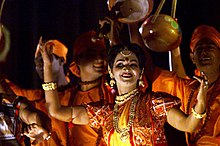
The music and dance styles of Bangladesh may be divided into three categories: classical, folk, and modern.
The classical style has been influenced by other prevalent classical forms of music and dances of the Indian subcontinent and, accordingly, show some influenced dance forms like Bharatnatyam and Kathak.
Several dancing styles in vogue in the northeastern part of the Indian subcontinent, like Manipuri and Santhali dances, are practised, but Bangladesh has developed its own distinct dancing styles. Bangladesh has a rich tradition of folk songs, with lyrics rooted in vibrant tradition and spirituality, mysticism, and devotion. Such folk songs revolve around other themes, including love. The most prevalent folk songs and music traditions include Bhatiali, Baul, Marfati, Murshidi, and Bhawaiya. Lyricists like Lalon Shah, Hason Raja, Kangal Harinath, Romesh Shill, Abbas Uddin, and many unknown anonymous lyricists have enriched the tradition of folk songs of Bangladesh.
In a relatively modern context, Robindro Shongit and Nazrul Giti form precious cultural heritage of Bangladesh. Recently, western influences have given rise to quality rock bands, particularly in urban centres like Dhaka. Several musical instruments, some of them indigenous, are used in Bangladesh, and major musical instruments used are the bamboo flute (bashi), drums (dhol), a single stringed instrument named ektara, a four-stringed instrument called dotara, and a pair of metal bawls used for rhythm effect called mandira, are important in the culture of Bangladesh. Currently,musical instruments of western origin like guitars, drums, and the saxophone are used, sometimes along with traditional instruments (Muajj).
The cinema of Bangladesh dates back to 1898, when films began screening at the Crown Theatre in Dacca. The first bioscope in the subcontinent was established in Dacca that year. The Dhaka Nawab Family patronised the production of several silent films in the 1920s and 30s. In 1931, the East Bengal Cinematograph Society released the first full-length feature film in Bangladesh, titled the Last Kiss. The first feature film in East Pakistan, Mukh O Mukhosh, was released in 1956. During the 1960s, 25–30 films were produced annually in Dacca. By the 2000s, Bangladesh produced 80–100 films a year. While the Bangladeshi film industry has achieved limited commercial success; the country has produced notable independent film makers. Zahir Raihan was a prominent documentary-maker who was assassinated in 1971. The late Tareque Masud is regarded as one of Bangladesh's outstanding directors due to his numerous productions on historical and social issues. Masud was honoured by FIPRESCI at the Cannes Film Festival in 2002 for his film The Clay Bird. Tanvir Mokammel, Mostofa Sarwar Farooki, Humayun Ahmed, Alamgir Kabir, Subhash Dutta and Chashi Nazrul Islam are other prominent directors of Bangladesh cinema.
HTML Image as link
The following image works as a link:


The second most important religious festival. The celebration of Eid
ul-Adha is similar to Eid ul-Fitr in many ways. The only big difference
is the Qurbani or sacrifice of domestic animals on Eid ul-Adha. Numerous temporary marketplaces of different sizes called hat operate in the big cities for sale of Qurbani animals (usually cows, goats
and sheep). In the morning on the Eid day, immediately after the
prayer, affluent people thank God for the animal, and then sacrifice it.
Less affluent people also take part in the festivity by visiting houses
of the affluent who are taking part in qurbani. After the qurbani, a
large portion of the meat is given to the poor people. Although the
religious doctrine allows the sacrifice anytime over a period of three
days starting from the Eid day, most people prefer to perform the ritual
on the first day of Eid. However, the public holiday spans over three
to four days. Many people from the big cities go to their ancestral
houses and homes in the villages to share the joy of the festival with
friends and relatives.

A traditional wedding is arranged by Ghotoks (matchmakers),
who are typically friends or relatives of the couple. The matchmakers
facilitate the introduction, and also help agree the amount of any
settlement. Bengali weddings are traditionally in five parts: first it
is the bride and groom's Mehendi Shondha, the bride's Gaye Holud, the groom's Gaye Holud, the Beeya, and the Bou Bhaat.
These often take place on separate days. The first event in a wedding
is an informal one: the groom presents the bride with a ring marking the
"engagement" which is gaining popularity. For the mehendi shondha the bride's side apply henna to each other as well as the bride for the bride's Gaye Holud, the groom's family – except the groom himself – go in procession to the bride's home. Bride's friends and family apply turmeric paste to her body as a part of Gaye Hoof bride, and they are traditionally all in matching clothes, mostly orange. The bride is seated on a dais, and the henna
is used to decorate the bride's hands and feet with elaborate abstract
designs. The sweets are then fed to the bride by all involved, piece by
piece. The actual wedding ceremony
"Biye" follows the Gaye Holud ceremonies. The wedding ceremony is
arranged by the bride's family. On the day, the younger members of the
bride's family barricade the entrance to the venue, and demand a sort of
admission charge from the groom in return for allowing him to enter.
The bride and groom are seated separately, and a Kazi (authorised person by the govt. to perform the wedding), accompanied by the parents and a Wakil
(witness) from each side formally asks the bride for her consent to the
union, and then the groom for his. The bride's side of the family tries
to play some kind of practical joke on the groom such as stealing the
groom's shoe. The reception, also known as Bou-Bhaat
(reception), is a party given by the groom's family in return for the
wedding party. It is typically a much more relaxed affair.










Contents
Music, dance, drama
See also: Music of Bangladesh and Performing arts of Bangladesh

Bangladeshi artists performing in a dance show.
The classical style has been influenced by other prevalent classical forms of music and dances of the Indian subcontinent and, accordingly, show some influenced dance forms like Bharatnatyam and Kathak.
Several dancing styles in vogue in the northeastern part of the Indian subcontinent, like Manipuri and Santhali dances, are practised, but Bangladesh has developed its own distinct dancing styles. Bangladesh has a rich tradition of folk songs, with lyrics rooted in vibrant tradition and spirituality, mysticism, and devotion. Such folk songs revolve around other themes, including love. The most prevalent folk songs and music traditions include Bhatiali, Baul, Marfati, Murshidi, and Bhawaiya. Lyricists like Lalon Shah, Hason Raja, Kangal Harinath, Romesh Shill, Abbas Uddin, and many unknown anonymous lyricists have enriched the tradition of folk songs of Bangladesh.
In a relatively modern context, Robindro Shongit and Nazrul Giti form precious cultural heritage of Bangladesh. Recently, western influences have given rise to quality rock bands, particularly in urban centres like Dhaka. Several musical instruments, some of them indigenous, are used in Bangladesh, and major musical instruments used are the bamboo flute (bashi), drums (dhol), a single stringed instrument named ektara, a four-stringed instrument called dotara, and a pair of metal bawls used for rhythm effect called mandira, are important in the culture of Bangladesh. Currently,musical instruments of western origin like guitars, drums, and the saxophone are used, sometimes along with traditional instruments (Muajj).
Media and cinema
Main articles: Media of Bangladesh and Cinema of Bangladesh
The Bangladeshi press is diverse, outspoken and privately owned. Over 200 newspapers are published in the country. Bangladesh Betar is the state-run radio service.[1] The British Broadcasting Corporation operates the popular BBC Bangla news and current affairs service. Bengali broadcasts from Voice of America are also very popular. Bangladesh Television (BTV) is the state-owned television network. There more than 20 privately owned television networks, including several news channels. Freedom of the media remains a major concern, due to government attempts at censorship and harassment of journalists.The cinema of Bangladesh dates back to 1898, when films began screening at the Crown Theatre in Dacca. The first bioscope in the subcontinent was established in Dacca that year. The Dhaka Nawab Family patronised the production of several silent films in the 1920s and 30s. In 1931, the East Bengal Cinematograph Society released the first full-length feature film in Bangladesh, titled the Last Kiss. The first feature film in East Pakistan, Mukh O Mukhosh, was released in 1956. During the 1960s, 25–30 films were produced annually in Dacca. By the 2000s, Bangladesh produced 80–100 films a year. While the Bangladeshi film industry has achieved limited commercial success; the country has produced notable independent film makers. Zahir Raihan was a prominent documentary-maker who was assassinated in 1971. The late Tareque Masud is regarded as one of Bangladesh's outstanding directors due to his numerous productions on historical and social issues. Masud was honoured by FIPRESCI at the Cannes Film Festival in 2002 for his film The Clay Bird. Tanvir Mokammel, Mostofa Sarwar Farooki, Humayun Ahmed, Alamgir Kabir, Subhash Dutta and Chashi Nazrul Islam are other prominent directors of Bangladesh cinema.
Festivals and celebrations
Festivals and celebrations are an integral part of the culture of Bangladesh. Muslim festivals of Eid ul-Fitr, Eid ul-Adha, Milad un Nabi, Muharram, Chand raat, Shab-e-Baraat, Bishwa Ijtema; Hindu festivals of Durga Puja, Rath Yatra, Janmashtami; Buddhist festival of Buddha Purnima; Christian festival of Christmas and secular festivals like Pohela Boishakh, Language Movement Day, Independence Day, Rabindra Jayanti, Nazrul Jayanti witness widespread celebrations and are national holidays in Bangladesh.Eid ul-Fitr
Main article: Eid ul-Fitr
As the most important religious festival for the majority of Muslims,
the celebration of Eid ul-Fitr has become a part of the culture of
Bangladesh. The government of Bangladesh declares the holiday for three
days on Eid-ul Fitr. But practically, all schools, colleges and offices
remain closed for a week. This is the happiest time of the year for most
of the people in Bangladesh. All outgoing public transport from the
major cities have become highly crowded and in many cases the fares tend
to rise in spite of government restrictions. On Eid day, the Eid prayers are held all over the country, in open areas like fields, Eidgahs or inside mosques.[2] After the Eid prayers, people return home, visit each other's home and eat sweet dishes called Shirini, Sheer Khurma
and other delicacies like biryani, korma, haleem, kebab etc. Throughout
the day people embrace each other and exchange greetings. It is also
customary for junior members of the society to touch the feet of the
seniors, and seniors returning blessings (sometimes with a small sum of
money as a gift). Money and food is donated to the poor. In the rural
areas, the Eid festival is observed with great fanfare. Quiet remote
villages become crowded. In some areas Eid fairs are arranged. Different
types of games including boat racing, kabaddi, and other traditional Bangladeshi games, as well as modern games like cricket and football
are played on this occasion. In urban areas, people play music, visit
each other's houses, arrange picnics and eat special food. The homes,
streets, markets and parks are illuminated with lighting decorations in
the evening. Watching movies and television programs has also become an
integral part of the Eid celebration in urban areas. All local TV
channels air special program for several days for this occasion.Eid ul-Adhha
Main article: Eid ul-Adha

An urban congregation for Eid-ul-Adha prayers in Dhaka.
Pohela Boishakh
Main article: Pohela Boishakh
Pôhela Boishakh is the first day of the Bengali calendar.
It is usually celebrated on 14 April. Pohela Boishakh marks the start
day of the crop season. Usually on Pôhela Boishakh, the home is
thoroughly scrubbed and cleaned; people bathe early in the morning and
dress in fine clothes. They spend much of the day visiting relatives,
friends, and neighbours and going to the fair. Fairs are arranged in
many parts of the country where various agricultural products,
traditional handicrafts, toys, cosmetics, as well as various kinds of food and sweets are sold. The fairs also provide entertainment, with singers, dancers and traditional plays and songs. Horse races, bull races, bullfights, cockfights, flying pigeons, and boat racing
were once popular. All gatherings and fairs consist a wide spread of
Bengali food and sweets. The most colourful New Year's Day festival
takes place in Dhaka. Large numbers of people gather early in the morning under the banyan tree at Ramna Park where Chhayanat artists open the day with Rabindranath Tagore's famous song, Esho, he Boishakh, Esho esho (Come, year, come, come). A similar ceremony welcoming the new year is also held at the Institute of Fine Arts (Dhaka) and University of Dhaka.
Students and teachers of the institute take out a colourful procession
and parade to round the campus. Social and cultural organisations
celebrate the day with cultural programmes. Newspapers bring out special
supplements. There are also special programmes on radio and television.
Prior to this day, special discounts on clothes, furniture, electronics
and various deals and shopping discounts are available. Special line of
saree, usually cotton, white sarees with red print and
embroidery is sold before this day as everyone dresses up for this day.
Jasmine and marigold flowers are also a huge sale for this event which
adorns the women's hair.Language day
Main article: International Mother Language Day
In 1952, the emerging middle classes of East Bengal underwent an
uprising known later as the Bangla Language Movement. Bangladeshis (then
East Pakistanis) were initially agitated by a decision by the Central
Pakistan Government to establish Urdu, a minority language spoken only
by the supposed elite class of West Pakistan, as the sole national
language for all of Pakistan. The situation was worsened by an open
declaration that "Urdu and only Urdu will be the national language of
Pakistan" by the governor, Khawaja Nazimuddin. Police declared Section
144 which banned any sort of meeting. Defying this, the students of
University of Dhaka and Dhaka Medical College and other political
activists started a procession on 21 February 1952. Near the current
Dhaka Medical College Hospital, police fired on the protesters and
numerous people, including Abdus Salam, Rafiq Uddin Ahmed, Sofiur
Rahman, Abul Barkat and Abdul Jabbar died. The movement spread to the
whole of East Pakistan and the whole province came to a standstill.
Afterwards, the Government of Pakistan relented and gave Bengali equal
status as a national language.This movement is thought to have sown the
seeds for the independence movement which resulted in the liberation of
Bangladesh in 1971. To commemorate this movement, Shaheed Minar (শহীদ
মিনার), a solemn and symbolic sculpture, was erected in the place of the
massacre. The day is revered in Bangladesh and, to a somewhat lesser
extent, in West Bengal as the Martyrs' Day. This day is the public
holiday in Bangladesh. UNESCO decided to observe 21 February as
International Mother Language Day. The UNESCO General Conference took a
decision to that took effect on 17 November 1999 when it unanimously
adopted a draft resolution submitted by Bangladesh and co-sponsored and
supported by 28 other countries.Durga Puja
Main article: Durga Puja
Durga Puja, largest religious festival for Hindus,
is celebrated widely across Bangladesh. Thousands of pandals (mandaps)
are set up in various villages, towns and cities. Durga Puja is a grand
cultural celebration in the capital city of Dhaka.
Major pujas of Dhaka are held in numerous pandals, but the biggest
celebration takes place at Dhakeshwari Temple where several thousand
worshippers and onlookers stream through the premises for four days.
Special boat race on Buriganga river is arranged and it attracts a large
crowd. A five-day holiday is observed by all educational institutions,
while Bijoya Dashami is a national holiday. On Bijoya Dashami, effigies are paraded through the streets of Shankhari Bazaar in Old Dhaka
in loud, colourful processions before being immersed into the rivers.
Thousands of Muslims take part in the secular part of festivities in
celebration of Bengali solidarity and culture.Weddings
Main article: Bengali marriage

Relatives decorating the bride with traditional wedding turmeric in a Bangladeshi Gaye Holud ceremony in Dhaka.